International Tours
Bhutan Splendor
Bhutan Splendor is a deep, eight-day journey into the Last Shangri-La, reaching far beyond the usual Paro–Thimphu circuit to the central heartland of Trongsa and the sacred valleys of Bumthang. Flying in by Druk Air over the Himalaya, you cross high passes like Dochula and Pele La, visit the great fortress-monasteries known as dzongs, and travel a country that measures progress in Gross National Happiness. It is the fullest Bhutan itinerary we run.
Tour overview
Most Bhutan trips stop at Thimphu and Paro; this one keeps going east, across the Black Mountains to Trongsa and on to Bumthang, the spiritual cradle of the kingdom, before looping back through the warm river valley of Punakha. That gives you the full sweep of Bhutanese landscape — pine forests and rhododendron passes, terraced fields, and rivers running clear beneath towering white dzongs — along with the temples and museums that tell the country's Buddhist story.
Era Tours has arranged Himalayan travel for 25 years, and Bhutan rewards the traveller who takes it slowly. Everything below is our recommended flow, driven privately with a local guide throughout. Distances are short in kilometres but long in hours because the mountain roads wind, so we have paced the days to leave time for the views. We tailor the hotels, the walking and the pace to your interests, whether that is photography, Buddhist heritage or simply the mountain air.
The great dzongs
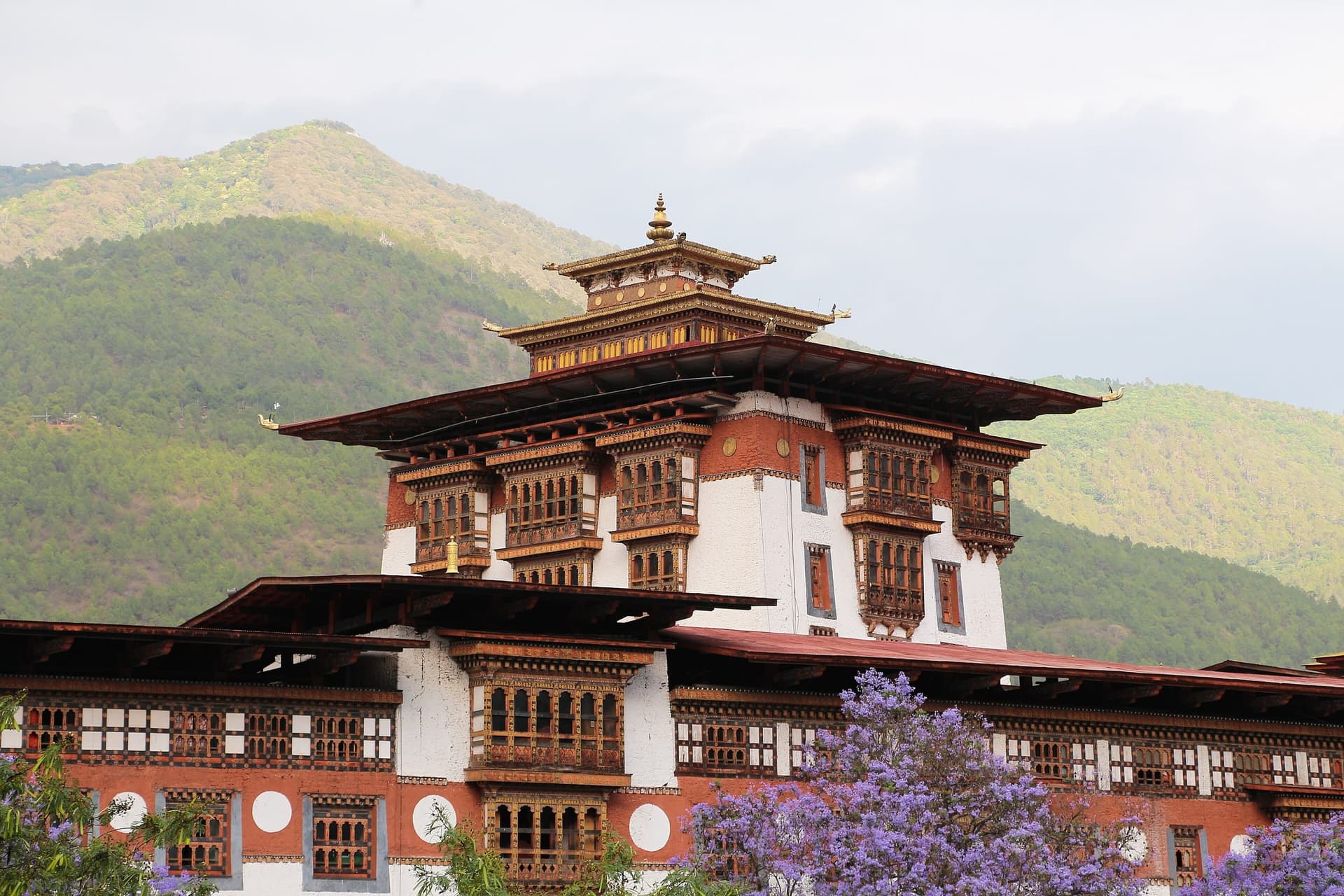
Trashichhodzong in Thimphu, Trongsa Dzong straddling its ridge, and the sublime Punakha Dzong at the meeting of two rivers — Bhutan's fortress-monasteries are among the finest architecture in the Himalaya.
Into Bumthang
Few visitors reach the four sacred valleys of Bumthang, where Kurje Lhakhang, Jambey Lhakhang and Tamshing Monastery anchor the kingdom's deepest Buddhist roots.
High Himalayan passes
Dochula, Pele La and Yutong La deliver sweeping views of snow peaks, prayer flags and cloud forest as you cross from valley to valley.
Day-by-day itinerary
8 daysYour Druk Air flight into Paro is one of the world's most dramatic mountain landings. You are met at the airport and driven to Thimphu, the capital, set in a wooded valley at around 2,300m. The rest of the day is at leisure to acclimatise. Overnight in Thimphu.
A full day in the Thimphu valley. You visit the National Library, famous for its collection of Buddhist texts and manuscripts; the Painting School (Institute for Zorig Chusum), where students learn Bhutan's traditional arts; the Traditional Medicine Institute; the Textile and Folk Heritage Museum; the Memorial Chorten built in memory of Bhutan's third king; the Handicrafts Emporium; and Trashichhodzong, the seat of government and the central monk body. Overnight in Thimphu.
- Memorial Chorten
- — A landmark white stupa built in 1974 in memory of the third king, always circled by pilgrims.
- Trashichhodzong
- — The "fortress of the glorious religion" housing the throne room and central monastery.
An early start for one of Bhutan's great drives. You climb to the Dochula Pass, where a stop offers views towards Gangkhar Puensum — at 7,497m the highest peak in Bhutan and one of the highest unclimbed mountains on earth. Continuing through Wangduephodrang for lunch, you cross the Pele La pass and pause at Chendebji Chorten, an 18th-century stupa built by the lama Shida. You reach Trongsa in the evening. Overnight in Trongsa.
- Dochula Pass
- — A 3,100m pass crowned with 108 chortens and, on clear days, a wall of Himalayan peaks.
You begin with Trongsa Dzong, built in 1647 and the ancestral seat of Bhutan's royal family, along with the Ta Dzong watchtower above it, now a museum dedicated to the monarchy. Then you drive to Bumthang, crossing the Yutong La pass after about 29 km. After lunch you explore the sacred valley: Kurje Lhakhang, where the saint Padmasambhava is said to have subdued a local demon and left his body-print in rock; Jambey Lhakhang; Tamshing Monastery; Jakar Dzong; and the Swiss Farm. Overnight in Bumthang.
- Kurje Lhakhang
- — One of Bhutan's holiest temples, marking a meditation site of Guru Padmasambhava.
- Trongsa Dzong
- — The kingdom's largest dzong, from which the Wangchuck dynasty rose to power.
A morning to enjoy the enchanting Bumthang valley before the long drive west, retracing your route to Trongsa for lunch and continuing to Punakha. On the way you visit Wangduephodrang and its dzong and town. Punakha, at a lower and warmer altitude, was the old winter capital of Bhutan. Overnight in Punakha.
The morning is given to Punakha Dzong, a vast and beautiful fortress at the confluence of the Pho Chhu and Mo Chhu rivers, still the site of royal coronations and weddings. After lunch you drive to Paro, stopping at a traditional Bhutanese farmhouse for a glimpse of rural life. Overnight in Paro.
- Punakha Dzong
- — The "palace of great happiness" set where two rivers meet, widely held to be Bhutan's most beautiful dzong.
A full day exploring the Paro valley. You visit Ta Dzong, the round watchtower above Paro that now serves as the National Museum, then drive to Drukgyel Dzong, built in 1647 to commemorate Bhutan's victory over Tibetan invaders. On the way you stop at Kyichu Lhakhang, one of the oldest and most sacred temples in the kingdom, dating to the 7th century. Overnight in Paro.
- Kyichu Lhakhang
- — A 7th-century temple, among the oldest in Bhutan.
After breakfast you are transferred to Paro airport for your onward flight, carrying home the calm of the last Buddhist Himalayan kingdom. Tour ends.
This itinerary is a suggested flow and is fully customisable — hotels, pace and sightseeing are tailored to you. Ask us to adjust it →
Places on this tour
What's included
- Accommodation on twin-sharing basis in your chosen hotel category
- Daily breakfast, with lunches and dinners as per the mountain itinerary
- Private vehicle with driver and a licensed Bhutanese guide throughout
- All arrival and departure transfers
- Sightseeing and monument visits as specified
- All applicable taxes on the services quoted
Not included
- Druk Air / international airfare and airport taxes
- Bhutan visa and applicable Sustainable Development Fee
- Meals not specified and all drinks
- Camera and video charges at monuments
- Tips, gratuities and personal expenses
- Anything not mentioned under inclusions
Ideal for: Culture and mountain lovers, photographers and unhurried travellers.
FAQ
Bhutan Splendor — your questions answered
Eight days lets you go well beyond the standard Paro–Thimphu loop. This itinerary uses that time to reach central Bhutan — Trongsa and the sacred Bumthang valleys — which most shorter trips miss, while still covering Thimphu, Punakha and Paro.
Spring (March to May) and autumn (September to November) are the best times to visit Bhutan. Spring brings blooming rhododendrons and clear passes, while autumn offers the crispest mountain views and many of the colourful tshechu festivals. Winter is cold but bright, and summer is green but wet.
You fly into Paro on Druk Air, and then travel entirely by private road. The distances between valleys are short in kilometres but take several hours because the roads wind over high Himalayan passes, so we pace the days gently and build in stops for the views.
Indian nationals do not need a traditional visa but must carry valid travel documents and obtain an entry permit, and a Sustainable Development Fee applies to visitors. We handle the permit process and advise on current requirements as part of arranging your trip; the fee itself is not included in the tour cost.
No, this is a cultural touring itinerary rather than a trek. You travel by private vehicle and explore dzongs, temples and valleys on foot with short, easy walks, so no special fitness or hiking experience is needed to enjoy it.