
Destination guide
Places to visit in Delhi
Our home city, seen through the eyes of an operator who has been meeting guests here since 1997: the monuments, markets and a sensible one and two-day plan.
Updated · Written by the Era Tours team, New Delhi
The best places to visit in Delhi are the Red Fort and Jama Masjid in the old walled city, Humayun's Tomb and the Qutub Minar from the medieval and Mughal centuries, and India Gate, the Lotus Temple and Akshardham for the New Delhi that followed. Our office is in this city, so this is not a scraped list: it is where we actually take guests, with the practical notes (Monday closures, dress codes, how to get around) that make the difference between a rushed transit day and a proper introduction to the capital.
Old Delhi: Red Fort, Jama Masjid & Chandni Chowk
The Red Fort, Shah Jahan's red sandstone citadel and seat of Mughal power for two centuries, is the natural starting point: go early to beat both the heat and the crowds, and allow an hour inside to see the marble pavilions of the Diwan-i-Khas and Diwan-i-Aam, where emperors once held court. A short walk away is Jama Masjid, India's largest mosque, whose vast courtyard holds many thousands at Friday prayers; climb the southern minaret for a rooftop view over the old city's rooftops and domes, if it is open on the day. Between the two runs Chandni Chowk, a seventeenth-century market lane laid out by Shah Jahan's daughter Jahanara, now a dense tangle of spice traders, jewellers, sari shops, wedding-card printers and some of the best street food in India. We usually walk this stretch with a local guide, since the lanes, side alleys and centuries-old havelis reward context you would otherwise miss entirely, from Sisganj Gurudwara to the paratha-wallahs of Paranthe Wali Gali.
Humayun's Tomb
Built in the 1560s by the widow of the Mughal emperor Humayun, this garden tomb is widely considered the direct architectural ancestor of the Taj Mahal, with the same symmetry, red sandstone and white marble inlay a full century before Agra. It sits inside a walled Persian-style charbagh garden, divided into quadrants by water channels, and is far less crowded than the Taj, which makes it an easy, unhurried visit even in peak season. The wider complex also holds Isa Khan's octagonal tomb and several smaller Mughal-era structures, so we usually give it closer to an hour than a quick drive-by, and pair it naturally with the Qutub Minar on the same day given how the two sit on opposite but comparable sides of the city.
Qutub Minar
At over seventy metres, the Qutub Minar is the tallest brick minaret in the world, begun in 1193 to mark the start of Muslim rule in Delhi and standing at the heart of the city's oldest surviving monumental complex. The surrounding ruins, carved sandstone screens taken from earlier Hindu and Jain temples, and the famous iron pillar that has resisted rust for over a millennium make this an easy hour or two on foot, with genuinely striking detail in the calligraphy bands running up the tower itself. Come in the late afternoon if you can, when the light picks out the fluted sandstone and the gardens around the complex are at their most pleasant for a slow walk.
India Gate, Kartavya Path & the government quarter
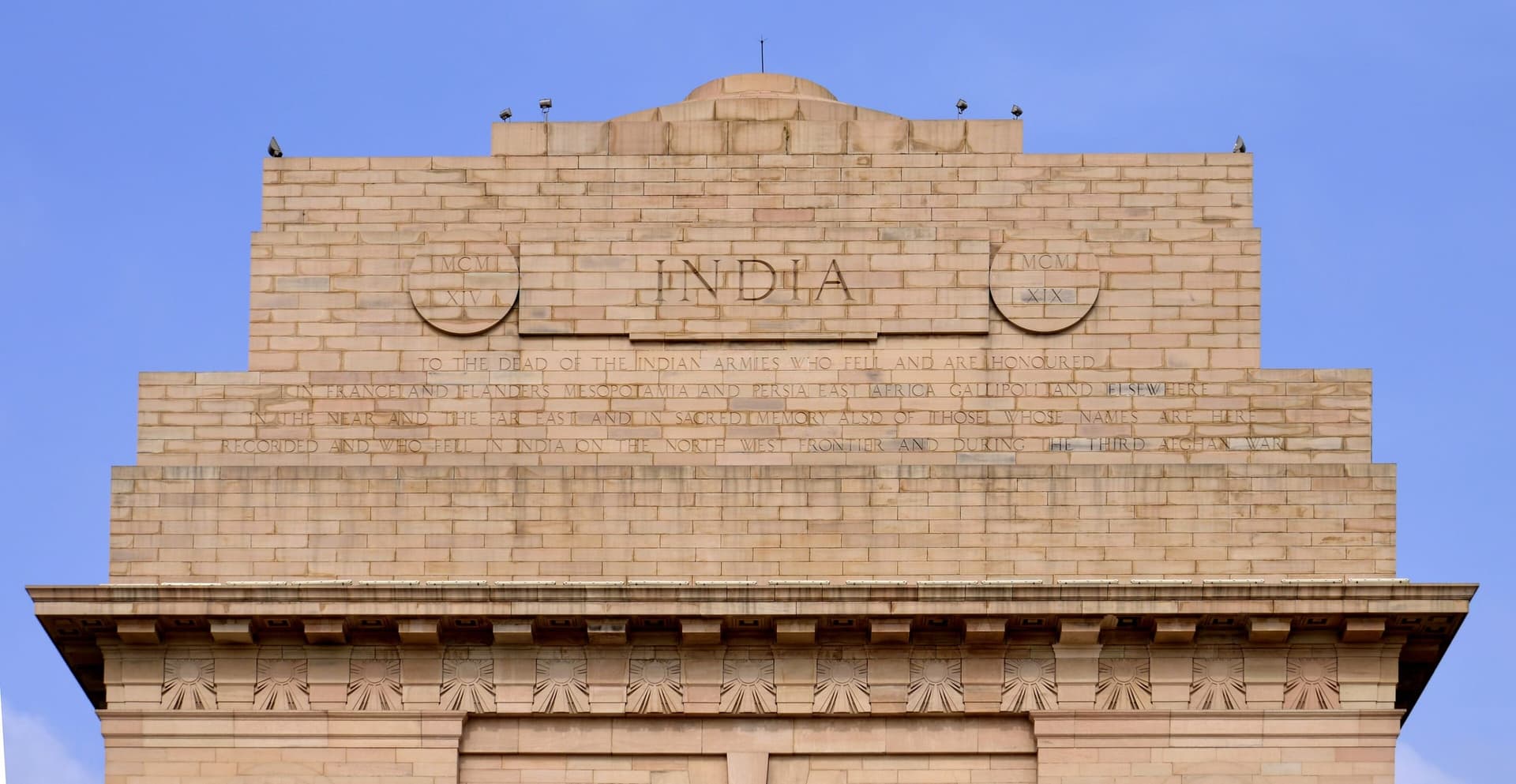
India Gate, the forty-two-metre sandstone war memorial at the head of Kartavya Path (formerly Rajpath), anchors Lutyens' imperial New Delhi and commemorates Indian and British soldiers of the First World War. The wide avenue running towards Rashtrapati Bhavan (the President's residence) and the domed North and South Block secretariats is at its best in the evening, when the lawns fill with families, ice cream carts and kite-flyers, and the memorial itself is lit against the dusk. It is a short, easy stop and works well combined with a slow drive past Parliament House, the nearby ministries, and the National War Memorial just behind India Gate, which honours soldiers from more recent conflicts.
Lotus Temple & Akshardham
The Lotus Temple, a Bahá'í house of worship shaped as an unfolding lotus in white marble and completed in 1986, welcomes visitors of every faith into its silent central hall for quiet reflection, and a visit takes around forty-five minutes including the queue at busy times. Akshardham, on the eastern bank of the Yamuna and opened in 2005, is a vast, intricately hand-carved modern Hindu temple complex with landscaped gardens, a musical fountain and an exhibition on Indian culture and philosophy; a full visit takes two to three hours, and note that bags, cameras and phones are not permitted inside, only lockers at the entrance. Both sit on the same side of the city and, with some planning around timings, can be combined into a single afternoon.
Hauz Khas, Lodhi Garden & the markets
Hauz Khas combines a fourteenth-century reservoir, madrasa and tomb complex, all built under the Delhi Sultanate, with one of Delhi's trendiest urban villages of cafes, boutiques and small galleries wrapped around it, a good half-day for guests who want history and a contemporary Delhi neighbourhood in the same stop. Lodhi Garden, a short drive away, holds three fifteenth-century tomb complexes inside a landscaped park popular with morning walkers, yoga groups and picnicking families, a calmer, greener counterpoint to the busier monuments. For markets, Chandni Chowk covers the historic end of the spectrum; Dilli Haat is a permanent open-air crafts market bringing artisans from every Indian state under one roof, with a small entry fee and genuinely good souvenir shopping; and Khan Market and Sarojini Nagar bookend the modern city, from boutique and bookshop browsing to high-volume bargain fashion. We weave whichever of these fits your interests and remaining time into the day.
A one-day Delhi plan
Morning: the Red Fort, then Jama Masjid and a guided walk through Chandni Chowk, finishing with a paratha or a glass of sugarcane juice in the lanes. Afternoon: drive past India Gate and along Kartavya Path, then Humayun's Tomb or the Qutub Minar, depending on which side of the city you are staying and how the traffic looks that day. Evening: the Lotus Temple or Akshardham if timings allow, or simply a slow drive past Kartavya Path lit up after dark, with dinner in a Connaught Place or Hauz Khas restaurant to close the day. It is a full day, but a private car and driver make it comfortable rather than exhausting, and we build in flexibility for traffic and heat.
A two-day Delhi plan
Day one covers Old Delhi in the morning (Red Fort, Jama Masjid, Chandni Chowk) and India Gate, Kartavya Path and the government quarter in the afternoon, finishing with dinner in a lively New Delhi neighbourhood. Day two takes the Qutub Minar and Humayun's Tomb in the morning, when the light and the temperature are both kinder, then Hauz Khas or Lodhi Garden and the Lotus Temple or Akshardham in the afternoon, with a market stop worked in wherever there is spare time before an evening flight or an onward drive. This is the pace we recommend before heading on to Agra and Jaipur on the Golden Triangle, and it is also how we plan Delhi within a longer India itinerary.
Practical notes
Most ASI-ticketed monuments, the Red Fort included, close on Mondays, though the Qutub Minar and Humayun's Tomb stay open daily, and we check the current schedule against your travel dates before finalising anything, since closures and timings do shift from year to year. The Delhi Metro reaches most major sights and is a genuinely clean, efficient way to get around, though for a short visit we usually arrange a private car with driver, since it saves real time between spread-out sights and copes far better with Delhi's heat, distances and traffic than switching repeatedly between metro stations and auto-rickshaws. Dress modestly and carry a scarf for Jama Masjid and Akshardham, wear comfortable shoes since most sights involve a fair amount of walking on uneven stone, and expect airport-style security at Akshardham, where bags and phones are not allowed inside, only lockers at the entrance gate. For the wider question of how Delhi and India feel for visitors, see our is India safe guide.
FAQ
Places to visit in Delhi: frequently asked questions
The places we send most guests to are the Red Fort and Jama Masjid in Old Delhi, Humayun’s Tomb, the Qutub Minar, India Gate and Kartavya Path, the Lotus Temple and Akshardham. Together they cover Mughal Delhi, colonial New Delhi and modern spiritual Delhi in roughly two days, which is the amount of time we recommend for a first visit.
One day is enough for a focused taste, not the whole city. A sensible one-day plan pairs Old Delhi (Red Fort, Jama Masjid, Chandni Chowk) in the morning with India Gate, Humayun’s Tomb or the Qutub Minar in the afternoon. If your dates allow it, we always recommend a second day so you are not rushing between sights in Delhi traffic.
Most of Delhi’s ticketed ASI monuments, including the Red Fort, close on Mondays, and several museums follow the same schedule. The Qutub Minar and Humayun’s Tomb stay open daily. We always check the current schedule against your dates before finalising an itinerary, since closures do shift.
Yes, the Delhi Metro is clean, efficient and covers most major sights, including stations near the Red Fort, Qutub Minar and Akshardham. For a short visit, though, we usually arrange a private car with driver, since it saves time between spread-out sights and handles Delhi’s heat, traffic and distances better than switching between metro and auto-rickshaws.
Two days is the ideal length for Delhi, enough to cover Old and New Delhi properly with time for a market or two. One day works if Delhi is just a stopover before Agra and Jaipur. Three days lets you add Hauz Khas, Lodhi Garden and a slower pace through the museums and markets.
Loose, breathable clothing that covers shoulders and knees works best, both for comfort in Delhi’s heat and for entry to religious sites such as Jama Masjid and Akshardham, which enforce modest dress. Carry a scarf or shawl for impromptu coverage, and comfortable shoes, since most sights involve a fair amount of walking.
Want a private guided day in Delhi?
Tell us your dates and how much time you have, and our Delhi-based team will put together a private car, driver and guide to cover exactly the places that matter to you.